The soundtrack is currently available as an MP3 from a number of online retailers, notably, Amazon, CD Baby, Google Marketplace and iTunes.
Showing posts with label Sound/Music. Show all posts
10.12.2012
9.01.2012
Experience the Many Dimensions of Nightscape
As diligent (and patient) readers of this blog know, the film will be supported by a series of ancillary products. The most immediate releases inlcude an original novel, a video game and the film's soundtrack. I'll go into greater depth on each of these endeavors as their street dates near. In the meantime, here's a brief overview:
Despite the ages of the book's main characters, it's not a young adult (YA) novel. It's a work of literary horror intended for a mature audience. The question at the heart of the book is: What does it mean to be human? It’s darkly philosophical in the tradition of H.P. Lovecraft and shouldn't be confused with standard paperback horror. The main protoganist, Case, is a 16-year-old math prodigy with a particular fascination with the mathematics around infinity. His mathematical obsession is intimately tied to the nature of the story's supernatural threat.
The book includes a bonus short story, "Auto-da-Fé, American-style," which serves as a direct prequel to the film. It will be available on October 9th in both print and eBook editions from Amazon and other retailers.
In this free iOS action-driving game, your goal is to outrace a nefarious phantom car through a series of rural burgs in a tricked out El Camino. The phantom car slows your progress by transforming hapless bystanders into tentacled monsters. You can evade or destroy these creatures using a variety of power ups, including a nitro boost, a spike drop, a demon-killing pistol, and a flamethrower. Your pursuit is further hampered by the ever-dogged police. With three difficulty settings and 15 levels, the game offers 16-bit-style fun for casual and hardcore gamers alike. Look for it starting September 25th on iTunes.
John had this to say about the experience of making it: “[David] Edwards created a unique world for his film Nightscape so the score needed to not only support this in sound and feel but also needed to be an additional, tweaked, layer to the setting and the story. In the end, a very industrial palate was developed by recording percussive car sounds for drums, 8-cylinder engine idles for drones and, by good luck, some random chain scrapes and tool squeaks from a machine shop became key melodic tones throughout. These created sounds with a blatant hat-tip to Tangerine Dream and Wendy / Walter Carlos made for some pretty weird score!”
The soundtrack consists of 20 tracks and clocks in at nearly 60 minutes. In addition to the original score, the soundtrack includes the garage rock song, “Save Yourself (Cuz No One Else Will).” This track, performed by Monster-Sized Monsters (fronted by the film’s lead actress Emily Galash), ties directly into the prequel short story included in the book. The soundtrack also contains the catchy Casio-inspired theme from the iOS video game.
The soundtrack will be available in both MP3 and limited edition CD formats via a number of online retailers, notably, Amazon, CD Baby, Google Marketplace and iTunes. The suggested MSRP is $9.99 for the digital version and $11.99 for the CD. I anticipate pre-orders will be available starting September 18th.
Pretty exciting lineup of tie-ins, eh? Look for our ads in upcoming issues of Rue Morgue, Shock Cinema, Scream and Screem (yes, two separate genre mags with nearly identical titles) and help spread the word. The Leviathan is heading your way...
Nightscape: The Dreams of Devils
This original novel has its origins in the first unproduced Nightscape-related screenplay I wrote. The book concerns three high school seniors who gain unwanted paranormal powers. They have to uncover the source and purpose of these powers in order to prevent the collapse of earthly reality. The book features two characters from the film, though in decidedly different guises. What makes it possible for one of those characters to appear is revealed in a climactic twist.Despite the ages of the book's main characters, it's not a young adult (YA) novel. It's a work of literary horror intended for a mature audience. The question at the heart of the book is: What does it mean to be human? It’s darkly philosophical in the tradition of H.P. Lovecraft and shouldn't be confused with standard paperback horror. The main protoganist, Case, is a 16-year-old math prodigy with a particular fascination with the mathematics around infinity. His mathematical obsession is intimately tied to the nature of the story's supernatural threat.
The book includes a bonus short story, "Auto-da-Fé, American-style," which serves as a direct prequel to the film. It will be available on October 9th in both print and eBook editions from Amazon and other retailers.
Nightscape: Phantom Fast Racing
In this free iOS action-driving game, your goal is to outrace a nefarious phantom car through a series of rural burgs in a tricked out El Camino. The phantom car slows your progress by transforming hapless bystanders into tentacled monsters. You can evade or destroy these creatures using a variety of power ups, including a nitro boost, a spike drop, a demon-killing pistol, and a flamethrower. Your pursuit is further hampered by the ever-dogged police. With three difficulty settings and 15 levels, the game offers 16-bit-style fun for casual and hardcore gamers alike. Look for it starting September 25th on iTunes.
Nightscape: Original Motion Picture Soundtrack
Composer John Morgan Askew outdid himself on the film's spaghetti western meets retro-80s score. He's scored a number of indie films, notably, Calvin Marshall (2011), and worked uncredited on HBO's Deadwood. While I'm not above bias here, I think this soundtrack represents his best work yet.John had this to say about the experience of making it: “[David] Edwards created a unique world for his film Nightscape so the score needed to not only support this in sound and feel but also needed to be an additional, tweaked, layer to the setting and the story. In the end, a very industrial palate was developed by recording percussive car sounds for drums, 8-cylinder engine idles for drones and, by good luck, some random chain scrapes and tool squeaks from a machine shop became key melodic tones throughout. These created sounds with a blatant hat-tip to Tangerine Dream and Wendy / Walter Carlos made for some pretty weird score!”
The soundtrack consists of 20 tracks and clocks in at nearly 60 minutes. In addition to the original score, the soundtrack includes the garage rock song, “Save Yourself (Cuz No One Else Will).” This track, performed by Monster-Sized Monsters (fronted by the film’s lead actress Emily Galash), ties directly into the prequel short story included in the book. The soundtrack also contains the catchy Casio-inspired theme from the iOS video game.
The soundtrack will be available in both MP3 and limited edition CD formats via a number of online retailers, notably, Amazon, CD Baby, Google Marketplace and iTunes. The suggested MSRP is $9.99 for the digital version and $11.99 for the CD. I anticipate pre-orders will be available starting September 18th.
Pretty exciting lineup of tie-ins, eh? Look for our ads in upcoming issues of Rue Morgue, Shock Cinema, Scream and Screem (yes, two separate genre mags with nearly identical titles) and help spread the word. The Leviathan is heading your way...
1.24.2012
Putting the Genie Back in the Bottle
For the past several weeks I’ve been spending one or two days at the newkrackle audiblefx recording studio, home of my sound designer, Jason Edwards (no relation). Jason and I have been coaching the cast through ADR sessions in order to improve the sound mix. That’s ADR as in Automated Dialogue Recording, or alternately, Additional Dialogue Recording, otherwise known as ‘dubbing.’ ADR is the preferred industry term, presumably because dubbing makes it sound as though the filmmaker was forced to record new dialogue to mask on-set mistakes.
While that does occur, the main purpose of ADR is to give the sound designer maximum flexibility in treating the various sound elements. In the usual course of production, bits of dialogue come across as distorted or unplayable. Sometimes it’s due to the noise accompanying an on-set action that can’t be pantomimed. Sometimes it’s because the actor moved in a way that resulted in an off-mic line delivery or generated an unwanted fabric swish. If you’ve followed this blog for any length of time, you’ve gathered that there’s a fair amount of car mayhem in the film. As you might expect, there are several in-car conversations. Given that we couldn’t afford a process trailer for more than a couple of days, we recorded most of these conversations with the car in motion, engine running. This amounted to recording guide tracks for the inevitable ADR work, as the engine noise nearly drowned out the dialogue. (As an amusing aside, I was typically curled up in the back of the El Camino just out of camera range, clutching the sound recording equipment. I often had to keep as low a profile as possible, so I usually couldn’t see anything; I just listened for solid performances.)

Joshua St. James gives a scream during his Nightscape ADR session
It’s been nearly five months since the end of principal photography and none of my leads have ever done ADR before. It can be a serious challenge to any actor—even recognized veterans—because you not only have to recreate your performance, but do so in sync with what’s on-screen. That’s the epitome of the old saw about putting the genie back in the bottle. Luckily for us, our leads have done amazingly well. Emily Galash was the first to enter the ADR booth. She faced the daunting task of re-recording about 80% of her dialogue, mostly because of environmental issues like wind and unavoidable noises tied to on-screen action. She was typically fearless and knocked out her dialogue like a seasoned voice actor in short order. She compared her experience to playing Guitar Hero, matching dialogue to action in a remembered rhythm. Joshua St. James and Jorge Madrid have been equally adept at ADR work, quickly getting back into character and in some cases, even improving on their original performances.
I’m indebted to Jason and his assistant, Lou, for their infallible attention to detail. They’ve done an exceptional job of identifying all of the necessary ADR elements, even going so far as to record single words because of slight distortion—discrepancies that would likely go unnoticed by the average filmgoer. For them, it’s a matter of professional pride. And that’s what makes for a winning film. It takes all of the little things done right to make for a satisfying whole.
While that does occur, the main purpose of ADR is to give the sound designer maximum flexibility in treating the various sound elements. In the usual course of production, bits of dialogue come across as distorted or unplayable. Sometimes it’s due to the noise accompanying an on-set action that can’t be pantomimed. Sometimes it’s because the actor moved in a way that resulted in an off-mic line delivery or generated an unwanted fabric swish. If you’ve followed this blog for any length of time, you’ve gathered that there’s a fair amount of car mayhem in the film. As you might expect, there are several in-car conversations. Given that we couldn’t afford a process trailer for more than a couple of days, we recorded most of these conversations with the car in motion, engine running. This amounted to recording guide tracks for the inevitable ADR work, as the engine noise nearly drowned out the dialogue. (As an amusing aside, I was typically curled up in the back of the El Camino just out of camera range, clutching the sound recording equipment. I often had to keep as low a profile as possible, so I usually couldn’t see anything; I just listened for solid performances.)

Joshua St. James gives a scream during his Nightscape ADR session
I’m indebted to Jason and his assistant, Lou, for their infallible attention to detail. They’ve done an exceptional job of identifying all of the necessary ADR elements, even going so far as to record single words because of slight distortion—discrepancies that would likely go unnoticed by the average filmgoer. For them, it’s a matter of professional pride. And that’s what makes for a winning film. It takes all of the little things done right to make for a satisfying whole.
The Kindest Cut
As the saying goes, you make your film three times: once when you write it, again when you shoot it and lastly, when you edit it. I wish it were only three times. We’ve done more than 20 edits of the film and while we’ve been in picture-lock since mid-November, we’ll invariably make tweaks here and there up until final mastering. No wonder many filmmakers say they never watch their completed projects. Every time I see a cut, I see not just what’s on the monitor, but any number of alternate renditions.
It’s a bit like seeing the timestream branch before your eyes without the benefit of living out any of the alternate paths. Getting to picture-lock took about two-and-a-half months of daily editing. My skillful editor, Ben Mead, known primarily for award-winning documentaries like Brutal Beauty: Tales of the Rose City Rollers, compiled the first assembly edit as we shot the film. He made great progress on it, despite welcoming his first child into the world during the shoot (not on set, mind). Subsequent versions underwent a number of changes, though all of them followed the same basic structure, closely mirroring that of the shooting script. This process involved selecting the most effective shots from more than 600 minutes of footage and reconfiguring them into seemingly endless patterns. (Btw, we used primarily one camera—the Red One—though we occasionally employed a relatively inexpensive crash-cam and for two days of intensive car stunts, actually had the luxury of a two-camera setup.) At about the two-month mark, though, Ben and I determined we needed a fresh perspective.
That’s when I asked a friend-of-a-friend, the uber-talented editor and director, Gary Lundgren (Calvin Marshall), to come up from southern Oregon for a week to apply his brand of filmic magic. Gary got his start in the industry as an editorial assistant and has been part of the editing team for a number of Hollywood productions, including Ernest Dickerson’s Tales from the Crypt: Demon Knight (uncredited, for you IMDB checkers). Working frenetically over the course of a workweek, Gary and I whacked the then-110 minute edit down to a snappy 77 minutes. I can’t say this part was easy. Absolutely necessary, yes; easy, no. There were moments when I doubted my storytelling instincts. But the end result was well worth all the accompanying emotional turmoil. Sometimes the most drastic cut can be the kindest. Gary’s beady-eyed focus on narrative clarity and momentum established a surer, leaner baseline for the film.
From that point on, it was relatively easy for Ben and me to rework the film into its current svelte, but more emotionally-engaging, picture-locked form. The 77 minute version turned out to be a mite too fast and some of the edits required additional bits to flow properly. Ben restored a lot of the essential breathing room and I added a few diary-entry voice-overs to give the lone female lead a greater, more sympathetic voice than the pared-back version allowed. I also reconvened the crew for a day of soundless pickups designed to fill in a few fleeting, but nonetheless noticeable gaps, and to ease a couple of scene transitions. (For completists, we trialed a Red Epic camera, the camera used on the most recentUnderworld picture and the upcoming The Amazing Spider-Man, among other things.) The current cut is about 87 minutes without closing credits.
Now, we’re in the throes of sound design, music, special effects, color correction and all the other usual post-production activities. Every element is inextricably linked, which makes coordination a challenge. For instance, I originally intended to use a track from obscure 70s band, The Godz, over the main title sequence. When negotiations with the record company proved unduly trying, however, the composer, John Askew, offered up a score. And boy-howdy, I’m glad he did! It was a revelation that altered our initial plans about the use of score throughout the film and impacted a number of sound design elements. (We’re experimenting with tying score and sound effects together to a greater extent than typical studio fare à la David Lynch.) Fortunately for me, the post-production crew consists not only of seasoned veterans, but many of them have worked together over a number of projects, making the process relatively seamless.
We’re now looking at a March timeframe for final mastering—about seven months after the end of principal photography. Not bad considering the fitful nature of post. I’m trying not to rush it, but my anticipation is second only to the anticipation I felt during my wife’s pregnancies. It’s worse than any childhood Christmas for sure. I can’t hardly wait to show what we’ve got in store. Regardless of your feelings about the finished film, I guarantee you’ll find it uniquely compelling.
It’s a bit like seeing the timestream branch before your eyes without the benefit of living out any of the alternate paths. Getting to picture-lock took about two-and-a-half months of daily editing. My skillful editor, Ben Mead, known primarily for award-winning documentaries like Brutal Beauty: Tales of the Rose City Rollers, compiled the first assembly edit as we shot the film. He made great progress on it, despite welcoming his first child into the world during the shoot (not on set, mind). Subsequent versions underwent a number of changes, though all of them followed the same basic structure, closely mirroring that of the shooting script. This process involved selecting the most effective shots from more than 600 minutes of footage and reconfiguring them into seemingly endless patterns. (Btw, we used primarily one camera—the Red One—though we occasionally employed a relatively inexpensive crash-cam and for two days of intensive car stunts, actually had the luxury of a two-camera setup.) At about the two-month mark, though, Ben and I determined we needed a fresh perspective.
That’s when I asked a friend-of-a-friend, the uber-talented editor and director, Gary Lundgren (Calvin Marshall), to come up from southern Oregon for a week to apply his brand of filmic magic. Gary got his start in the industry as an editorial assistant and has been part of the editing team for a number of Hollywood productions, including Ernest Dickerson’s Tales from the Crypt: Demon Knight (uncredited, for you IMDB checkers). Working frenetically over the course of a workweek, Gary and I whacked the then-110 minute edit down to a snappy 77 minutes. I can’t say this part was easy. Absolutely necessary, yes; easy, no. There were moments when I doubted my storytelling instincts. But the end result was well worth all the accompanying emotional turmoil. Sometimes the most drastic cut can be the kindest. Gary’s beady-eyed focus on narrative clarity and momentum established a surer, leaner baseline for the film.
From that point on, it was relatively easy for Ben and me to rework the film into its current svelte, but more emotionally-engaging, picture-locked form. The 77 minute version turned out to be a mite too fast and some of the edits required additional bits to flow properly. Ben restored a lot of the essential breathing room and I added a few diary-entry voice-overs to give the lone female lead a greater, more sympathetic voice than the pared-back version allowed. I also reconvened the crew for a day of soundless pickups designed to fill in a few fleeting, but nonetheless noticeable gaps, and to ease a couple of scene transitions. (For completists, we trialed a Red Epic camera, the camera used on the most recentUnderworld picture and the upcoming The Amazing Spider-Man, among other things.) The current cut is about 87 minutes without closing credits.
Now, we’re in the throes of sound design, music, special effects, color correction and all the other usual post-production activities. Every element is inextricably linked, which makes coordination a challenge. For instance, I originally intended to use a track from obscure 70s band, The Godz, over the main title sequence. When negotiations with the record company proved unduly trying, however, the composer, John Askew, offered up a score. And boy-howdy, I’m glad he did! It was a revelation that altered our initial plans about the use of score throughout the film and impacted a number of sound design elements. (We’re experimenting with tying score and sound effects together to a greater extent than typical studio fare à la David Lynch.) Fortunately for me, the post-production crew consists not only of seasoned veterans, but many of them have worked together over a number of projects, making the process relatively seamless.
We’re now looking at a March timeframe for final mastering—about seven months after the end of principal photography. Not bad considering the fitful nature of post. I’m trying not to rush it, but my anticipation is second only to the anticipation I felt during my wife’s pregnancies. It’s worse than any childhood Christmas for sure. I can’t hardly wait to show what we’ve got in store. Regardless of your feelings about the finished film, I guarantee you’ll find it uniquely compelling.
10.03.2011
Nightscape Rock n' Roll
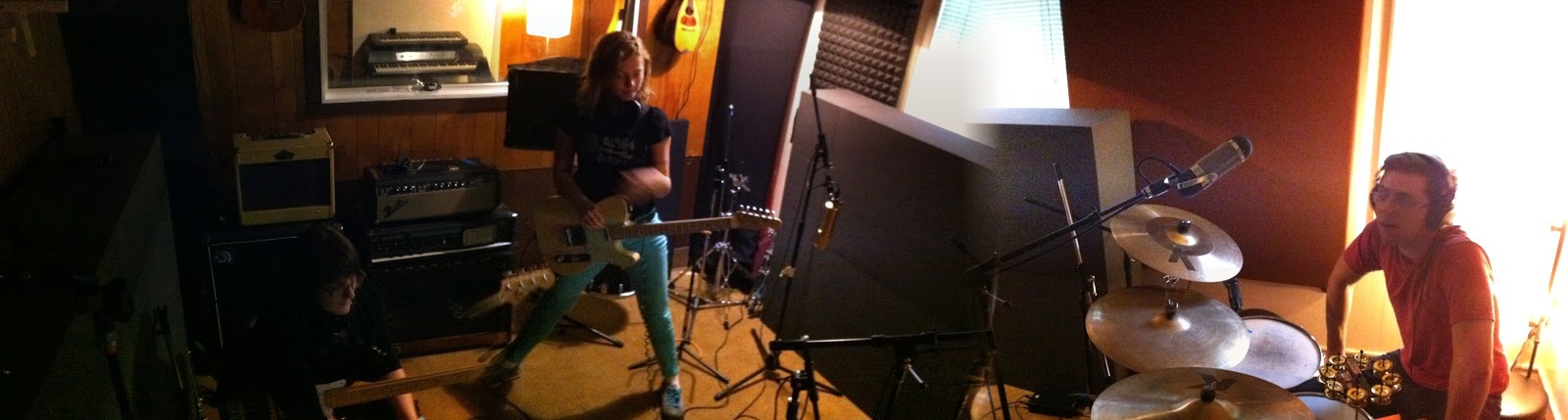
The short story that serves as a prequel to Nightscape, “Auto-da-Fe, American-style,” is set in the late-60s. As part of establishing the proper counterculture tone, it sports a series of (made up) song lyrics. The process of writing these lyrics led ineluctably to co-writing and recording a full-length song, “Save Yourself (Cuz No One Else Will).” I co-wrote the song with the film’s lead actress Emily Galash and her band Monster-Sized Monsters. (Well, I had the easy part of suggesting the song structure, providing some initial feedback and writing the lyrics; Emily and her cohorts did all the heavy lifting.) Needless to say, the group has crafted a supremely catchy tune that evokes songs like The Byrds’ “Eight Miles High” and The Beatles’ “She’s So Heavy.” I plan to make it available as part of the digital version of the tie-in book as well as feature it over the film’s end credits.
Monster-Sized Monsters recording "Save Yourself (Cuz No One Else Will)"
We recorded the foundational parts of the track last Friday in a marathon nine-hour session. The film’s composer, John Askew, served as our able guide and recording engineer. A veteran musician and producer, he provided invaluable feedback throughout the recording process. And because his studio boasts a number of vintage instruments, band members we’re able to perform with era-appropriate gear. We’ll be adding some instrumentation and mixing the song over the next few weeks (in-between various post-production tasks). The initial plan is to debut the song this spring in conjunction with the tie-in book and hopefully, our first major film festival screening. But I doubt I’ll be able to contain my enthusiasm for the track that long and will likely post a special preview sometime before year’s end. Maybe as a holiday present for those who enter our Facebook sweepstakes. So, if you haven’t entered yet, get to it. The sweepstakes ends October 21st.
Monster-Sized Monsters recording "Save Yourself (Cuz No One Else Will)"
We recorded the foundational parts of the track last Friday in a marathon nine-hour session. The film’s composer, John Askew, served as our able guide and recording engineer. A veteran musician and producer, he provided invaluable feedback throughout the recording process. And because his studio boasts a number of vintage instruments, band members we’re able to perform with era-appropriate gear. We’ll be adding some instrumentation and mixing the song over the next few weeks (in-between various post-production tasks). The initial plan is to debut the song this spring in conjunction with the tie-in book and hopefully, our first major film festival screening. But I doubt I’ll be able to contain my enthusiasm for the track that long and will likely post a special preview sometime before year’s end. Maybe as a holiday present for those who enter our Facebook sweepstakes. So, if you haven’t entered yet, get to it. The sweepstakes ends October 21st.
7.30.2011
The Roar of the Engines
Our interpid editor Ben Meader has put together a slick behind-the-scenes clip on the dyno recording session for our hero cars.
Check it out:
Subscribe to:
Comments (Atom)